
Will a Garage Floor Coating Survive Colorado Winters?
Colorado is genuinely hard on garage floors, and it is worth understanding why — because the same three forces that destroy bare concrete are the ones a properly specified coating is built to handle.
1. Freeze-thaw
The Front Range runs through freeze-thaw cycles constantly through the cold months. Daytime sun pushes above freezing, overnight temperatures drop well below it, and the cycle repeats.
Concrete is porous. Water gets into those pores, freezes, expands, and pushes the surface apart from the inside. Repeat that hundreds of times over a few winters and you get spalling — the flaking, crumbling surface damage most common just inside the garage door where snowmelt drips off the car and pools.
A coating seals the pores. Water cannot get in, so the freeze-thaw cycle has nothing to work on. That is the single biggest reason to coat a slab here rather than leave it bare.
2. Ice melt — the chemical attack
This is the one people underestimate. Colorado uses magnesium chloride heavily on the highways, and your tires bring it home. Every winter drive deposits a chemical film onto your garage floor.
Magnesium chloride is aggressive on concrete. It works into the pore structure, holds moisture against the slab, and accelerates the surface breakdown that freeze-thaw starts. Bare concrete in a Denver garage takes that treatment for four or five months a year.
Again, the fix is a sealed, non-porous surface. Once the slab is coated, the residue sits on top of a chemical-resistant film instead of soaking in. Rinse it out in the spring and the floor is unaffected.
3. Hot tire pickup — the altitude problem
At 5,280 feet the sun is intense. A dark car parked outside comes home in summer with genuinely hot tires, and when it parks on a coated floor, the hot rubber bonds to the coating surface.
If the coating is only weakly attached to the concrete, the tire wins. The coating lifts in patches shaped exactly like your tires. That is hot tire pickup, and it is the most recognisable failure in this trade.
It is not caused by cheap resin. It is caused by prep. A big-box kit relies on acid etching, which lightly opens the surface chemically but gives the primer nothing mechanical to key into. Diamond grinding physically opens the concrete’s pore structure so the primer locks in. A ground floor and an etched floor look identical the day they are finished — they look very different in year three.
What a Colorado-appropriate system looks like
Putting the three together, here is what we specify for a Denver garage:
- Diamond-ground prep, never acid etching. This is the whole ballgame for hot tire pickup and long-term bond.
- Cracks and spalls repaired first — chased, filled and levelled, not coated over. Freeze-thaw damage that already exists will keep moving if you ignore it.
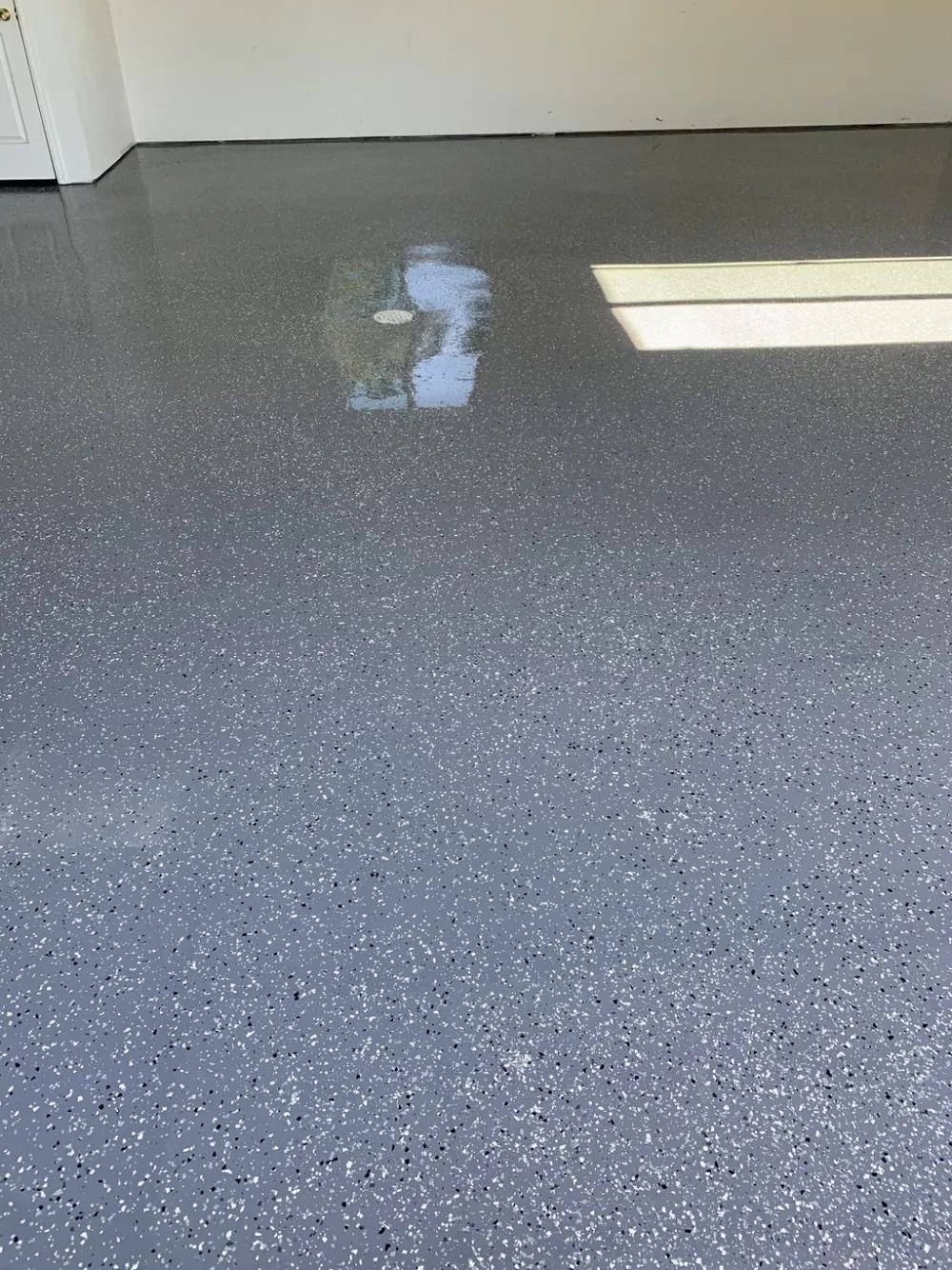
- A full-broadcast flake system. The chip profile gives texture underfoot, which matters when snowmelt pools by the door, and the blend hides winter grit and tire marks between cleans.
- A polyaspartic clear top coat. UV-stable so it will not amber at altitude, flexible enough to move with a slab going through freeze-thaw, chemical-resistant against ice melt, and it cures fast enough to install in cold weather when epoxy will not.
- Anti-slip aggregate at the entry where water gets tracked in.
Living with it
Maintenance is genuinely minimal. Sweep or dust mop, and mop with a mild cleaner when it needs it — nothing soaks in, because the floor is sealed.
The one seasonal habit worth having: rinse the floor down in spring. Ice melt residue that sits on any surface all winter is worth removing, and on a coated floor it takes five minutes with a hose and squeegee. Avoid harsh solvents, and put a mat under a car that drips.
That is the whole maintenance routine. Compared to watching a bare slab spall a little more every March, it is not much to ask.
If your garage floor is already showing the flaking and pitting that freeze-thaw leaves behind, that is repairable — it is prep work, not a reason to give up on the slab. Let us take a look and tell you what it needs.